How Much Exercise Does a Cocker Spaniel Need? Plus Brain Games
General training information. Every dog is an individual; for health or behavior concerns, see your veterinarian.
Ask three sources how much exercise a Cocker Spaniel needs and you may get three different answers. That is not you misreading. The published numbers really do disagree.
This guide helps you sort it out. You will build a daily routine in steps, add mental work that suits a gundog breed, and learn how to adjust as your dog changes. Every dog is an individual, so treat the numbers as a starting point, not a rule.
What the Sources Say About Cocker Spaniel Exercise
PetMD describes the Cocker Spaniel's exercise needs as moderate. Hill's Pet Nutrition NZ gives a figure of 20 to 40 minutes a day. The Royal Kennel Club in the UK lists more than two hours a day.
That is a wide gap. Part of it may come from how each source counts activity, such as a brisk walk versus a full day of play and work. None of them is the final word on your dog.
A practical way to use this: start near the lower, moderate end, then watch your own dog. A dog who settles calmly after activity and sleeps well is likely getting enough. A dog who chews furniture, barks for attention or cannot settle may need more activity, more mental work, or both. If you are unsure, ask your veterinarian.
One more point from the American Spaniel Club's breed standard: the Cocker should show a keen inclination to work. That is a clue that these dogs were built to do a job, and a job is more than a lap around the block.
What You Will Need
- A well-fitted flat collar or harness and a standard leash
- A long line (10 to 30 feet) for sniff walks in safe, legal areas
- Small, soft treats your dog loves, counted as part of the daily food allowance
- A puzzle feeder or a snuffle mat, or household items like a muffin tin and tennis balls
- A few cardboard boxes, old towels and paper bags
- A watch or phone timer
- A fenced area or a quiet spot for off-leash-style games (indoors works too)
Step-by-Step: Build a Daily Exercise and Brain Routine
Step 1: Start With a Baseline
For a healthy adult, a reasonable starting point is two or three outings a day that add up to roughly 30 to 60 minutes. This sits above the Hill's NZ range and well below the Royal Kennel Club figure, so you have room to adjust in either direction.
Write down what you do for a week. Note how your dog behaves in the evening. That record tells you more than any chart.
Step 2: Match Activity to Life Stage
Puppies. The sources we rely on do not give a specific minutes-per-day limit for Cocker puppies. Because growing joints are a real concern in any breed, and hip dysplasia is listed among the Cocker Spaniel's health issues by PetMD, ask your veterinarian what is safe for your puppy's age. Until you hear back, keep puppy outings short, on soft ground, and mixed with rest. Skip repetitive jumping and long forced runs.
Adults. Use the baseline from Step 1. Mix easy walks with some play and training so the day is not one long stroll.
Seniors. PetMD gives a life expectancy of 10 to 14 years, while Hill's NZ states 14 to 16 years, so the sources conflict. Whatever the number, watch for slowing down. Shorter, more frequent walks and more nose work, which is easy on the body, are often a good fit. Your vet can advise on any stiffness or changes you notice.
Step 3: Turn One Walk Into a Sniff Walk
A sniff walk is slow on purpose. You let your dog lead the pace and investigate smells, instead of marching along at your speed.
- Choose a safe, quiet route with plenty of grass, trees or edges.
- Clip the long line to a harness and let your dog explore within its length.
- Stop when your dog stops. Wait while they sniff.
- Every so often, say a cue like "let's go" and reward when they turn to follow you.
Many owners find that a 20-minute sniff walk leaves a dog more settled than a faster walk of the same length. Results vary from dog to dog.
Step 4: Swap Some Bowl Meals for Puzzle Feeders
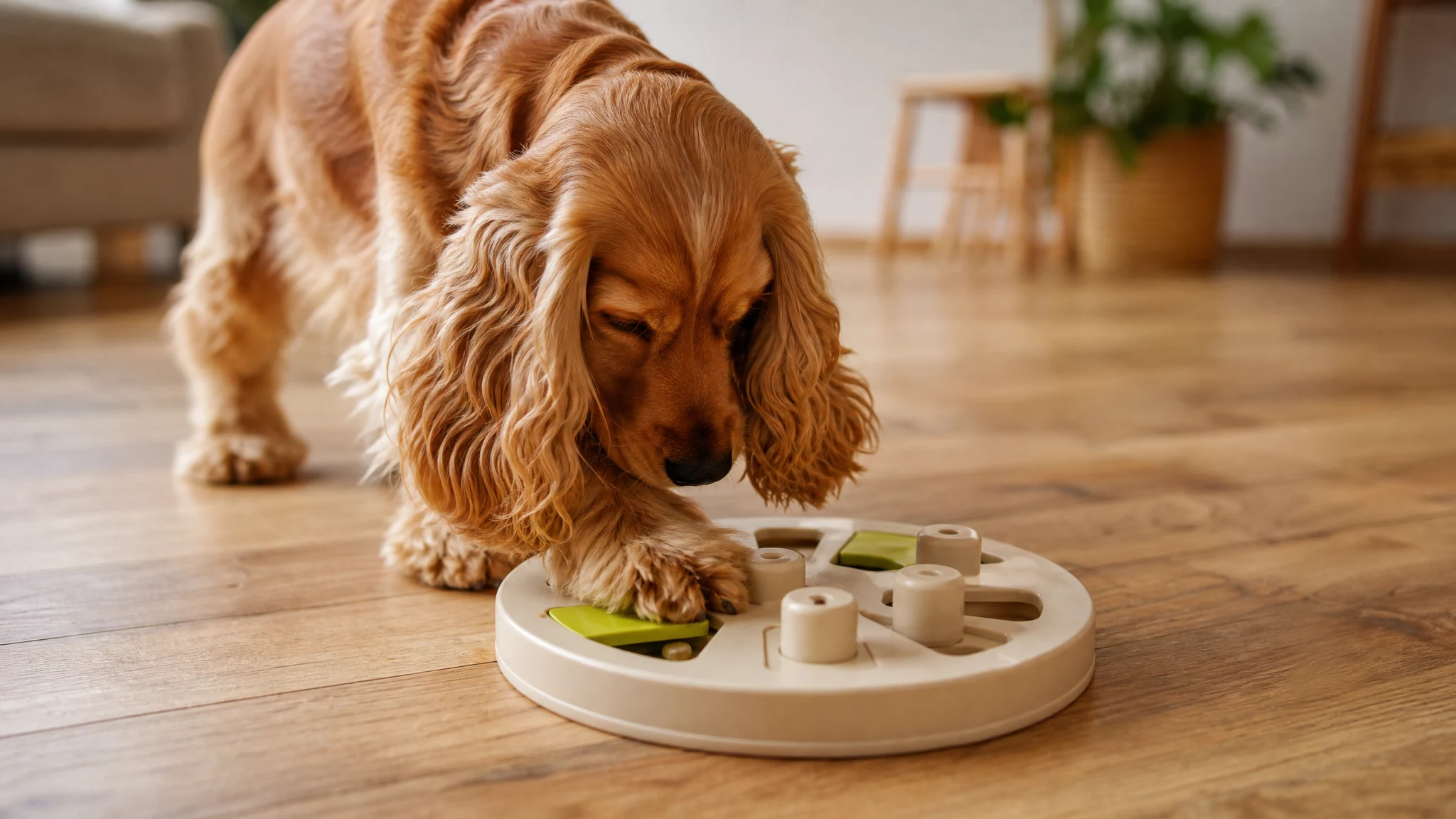
This is the easiest way to add cocker spaniel mental stimulation to a busy day. Instead of serving dinner in a bowl, make your dog work for part of it.
- Snuffle mat: scatter kibble in the folds and let your dog hunt it out.
- Muffin tin: put a few pieces in several cups and cover each with a tennis ball.
- Towel roll: sprinkle kibble on a towel, roll it up loosely and let your dog unroll it.
- Commercial puzzle feeder: begin with the easiest level, so your dog wins early.
Always stay nearby and pick up pieces that could be swallowed. If your dog gives up, make it easier next time.
Step 5: Play Training Games That Fit a Gundog
The American Spaniel Club notes the Cocker's gundog roots and keen inclination to work. These games borrow from that idea: find things, fetch things, follow cues.
Find It. Show your dog a treat, toss it a short distance and say "find it." As your dog gets the idea, hide treats under a towel or behind a chair leg. Later, hide them in another room.
Retrieve and deliver. Use a soft toy. Toss it a short way, praise your dog for picking it up, and trade a treat for the toy when they bring it back. Keep the game calm and short.
Box search. Line up four or five cardboard boxes and hide a treat in one. Let your dog sniff each one. Reward the right box with praise and a second treat.
Name the toy. Teach your dog the name of one toy, then add a second. Ask for one by name. This can take several weeks, and that is fine.
Short cue sessions. Spend two or three minutes on sit, down, touch or a hand target, rewarding every correct try. Our complete guide to training a Cocker Spaniel walks through those building blocks in more detail.
Keep every session short and end while your dog is still keen. The Royal Kennel Club notes that the breed does best with reward-based methods and can be sensitive to harsh handling, so keep your voice and body language light and friendly.
Step 6: Consider a Dog Sport
If your dog loves these games, a sport can give you structure. The American Spaniel Club lists field work, agility, rally, obedience, trick dogs and tracking among its programs. On rally, the club says Cockers are well suited to it. Its national specialty pairs conformation with obedience, rally and agility events.
You do not need to compete. Many people simply take a class for fun. Check with the American Spaniel Club or a local club for what is offered in your area, and ask about requirements before you sign up.
Step 7: Finish With a Calm Down
Not every activity should be exciting. End the day with a chew, a lick mat or a quiet settle on a mat with a few treats. Teaching a dog to relax is part of a healthy routine, and it may help evenings go more smoothly.
A Sample Day
| Time | Activity | Approx. length |
|---|---|---|
| Morning | Sniff walk or neighborhood walk | 20 to 30 minutes |
| Midday | Puzzle feeder or Find It game | 10 to 15 minutes |
| Afternoon | Training session plus short retrieve game | 10 to 15 minutes |
| Evening | Relaxed walk, then a chew or lick mat | 15 to 20 minutes |
Adjust the times to fit your dog's age, health and energy. This is a template, not a prescription.
Tips for Success
- Count the treats. Brain games use food. Reduce regular meals a little so the total stays reasonable, and ask your vet what is right for your dog.
- Rotate games. Dogs can lose interest in the same puzzle. Change it up through the week.
- Make it easy first. Early success builds confidence, which matters with a sensitive dog.
- Keep ears and coat in mind. PetMD notes that ears and coat need regular care and that ear infections are common. After walks through brush, water or mud, check and brush your dog, and call your vet if you see redness, odor or discomfort.
- Use the weather. On wet or hot days, shift more of the day to indoor nose work.
Common Mistakes to Avoid
- Treating exhaustion as the goal. A tired dog is not always a satisfied dog. Mental work often matters as much as miles.
- Too much, too young. Long runs, stairs and repeated jumping can be hard on a puppy's joints. Ask your vet about limits.
- Frantic ball chasing every day. It can wind a dog up rather than settle them. Mix in calm, thinking games.
- Using harsh corrections. The American Veterinary Society of Animal Behavior supports reward-based training. Shock, prong or choke collars, alpha rolls and scruffing have no place here, and a sensitive Cocker may shut down.
- Ignoring signs of pain. If your dog limps, lags or resists exercise they used to enjoy, see your veterinarian. Do not try to diagnose it at home.
- Skipping rest. Downtime is part of the plan.
What to Expect
With a steady routine, many owners notice their dogs seem calmer at home, settle more easily and are more interested in training. Some dogs may show less boredom-related chewing or barking. How fast this happens depends on the dog's age, history and personality, and some dogs take weeks to show a change.
If problems continue despite a good routine, talk to your veterinarian to rule out health causes, then consider working with a trainer who uses reward-based methods.
Health Notes Worth Knowing
The American Spaniel Club's CHIC program lists a hip evaluation through the OFA and an eye exam by a CAER ophthalmologist, both at age two or older. If you are getting a puppy, ask the breeder about these results. PetMD lists hip dysplasia and von Willebrand disease among conditions the breed can face. Your vet is the right person to ask how these relate to your dog's exercise.
Quick Summary
- Start with a moderate baseline and adjust to your dog.
- Respect life stages, and ask your vet about puppy and senior limits.
- Turn at least one walk a day into a sniff walk.
- Feed some meals from puzzle toys.
- Play search, retrieve and cue games that suit a gundog.
- Finish with calm time.