Leash Training a Cocker Spaniel: Pulling, Lunging and Loose-Leash Walking
General training information. Every dog is an individual; for health or behavior concerns, see your veterinarian.
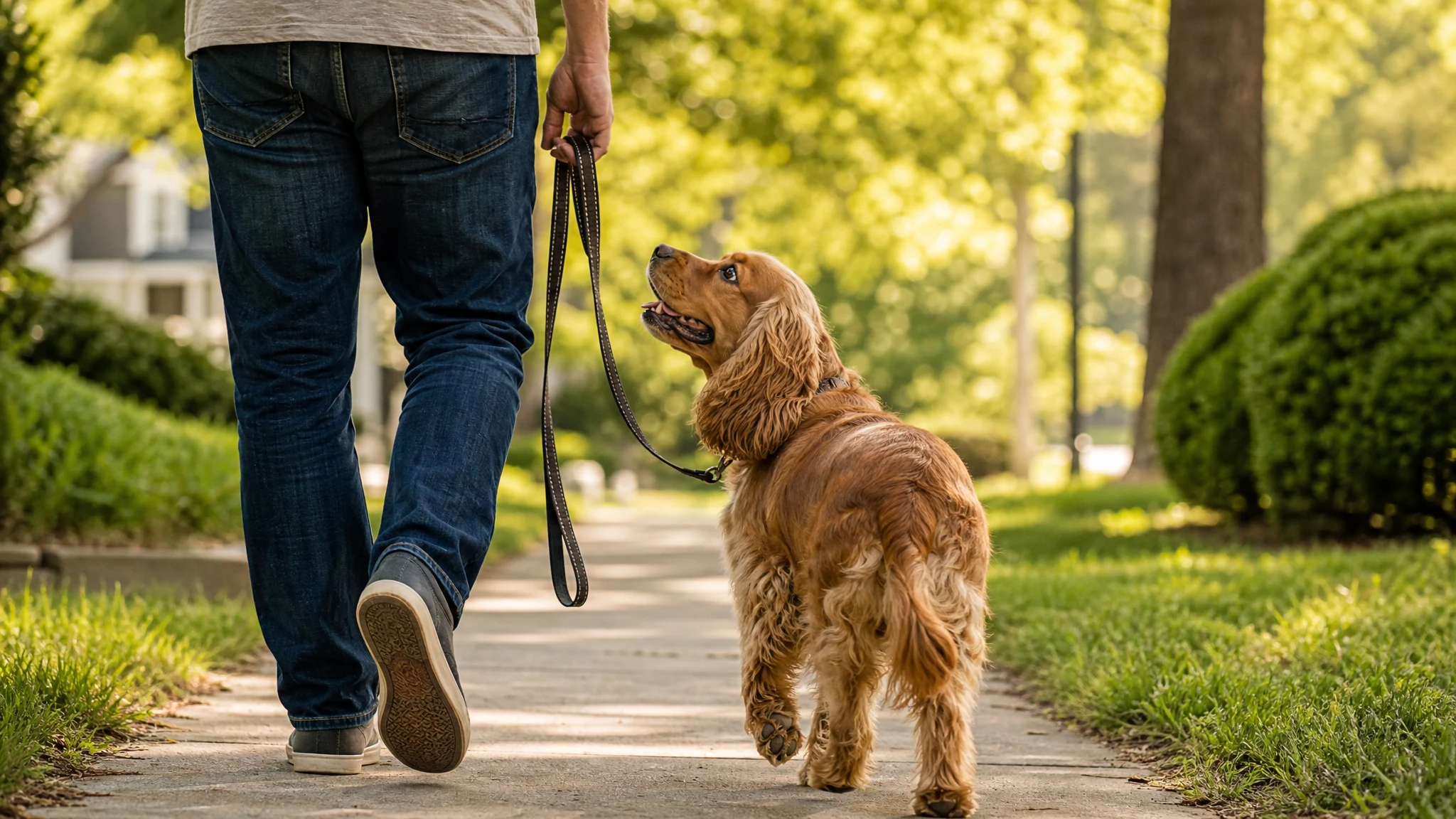
A Cocker Spaniel on a leash can look like a furry little tugboat. The nose goes down, the legs dig in, and you are towed toward whatever smells best. If that sounds familiar, you are in good company.
This guide shows how to leash train a Cocker Spaniel using patient, reward-based steps. It covers pulling, lunging at things that excite or worry your dog, and the games that build a calm, loose-leash walk. If you are still building the basics, start with our complete guide to training a Cocker Spaniel and come back here for the walking skills.
Why Cocker Spaniels Pull
Pulling is not a sign of a bad dog. It is a dog doing what works. Every time a tight leash gets your dog closer to a smell, a squirrel or a friend, the pulling is rewarded.
Breed history gives some clues too. The American Spaniel Club breed standard describes the Cocker Spaniel as a sporting dog that should show a keen inclination to work. The breed sits in the Sporting Group, and spaniels were developed as gundogs. A dog bred to work outdoors with its nose and attention on the environment will often find a walk very interesting.
Individual dogs vary a great deal, so treat that as background, not a prediction. Some Cockers are sniff-everything dogs. Others are people-greeters. Watch your own dog and notice what pulls them hardest.
The same standard calls the breed equable in temperament, with no suggestion of timidity. The Royal Kennel Club (UK) describes Cockers as typically gentle and eager to please. The Royal Kennel Club also notes that the breed is sensitive to harsh handling, and that reward-based methods started early work best. That fits everything below.
Materials You Will Need
- A flat collar or a front-clip harness. Pick one that fits snugly without rubbing. A front-clip harness attaches at the chest, so a pull turns your dog gently toward you instead of letting them lean into it.
- A standard 4 to 6 foot leash. Skip retractable leashes while you train. They teach dogs that pulling extends the leash.
- A long line (15 to 20 feet), optional. Useful for sniffing breaks in open, safe areas.
- Small, soft treats. Pea-sized pieces your dog can swallow fast. Use something special for busy places.
- A treat pouch. It keeps rewards at your hip so timing stays quick.
Please do not use prong, choke or shock collars. They work by causing discomfort, and the American Veterinary Society of Animal Behavior (AVSAB) recommends reward-based training instead. For a breed the Royal Kennel Club calls sensitive to harsh handling, they are especially a poor fit.
Keep each session short. Five to ten minutes of focused practice beats a long, frustrating walk.
How to Leash Train a Cocker Spaniel: Step by Step
1. Make the gear a good thing
Before any walking, let your dog meet the collar or harness and leash indoors. Show the gear, give a treat, then clip it on and give another treat. Let your dog wear it during meals or play for a few minutes, then take it off.
The goal is a dog who wiggles toward the leash, not away from it. Puppies often need a few days of this. Adult dogs who have been pulled around may need longer.
2. Teach attention in a quiet room
Say your dog's name or a cue like "look." When they turn toward you, mark with a cheerful "yes" and treat. Repeat ten times, then take a break.
This skill is the foundation of everything else. A dog who can check in with you has a way out of an exciting moment.
3. Teach the position you want
Stand with your dog on one side, whichever you prefer, and keep that side consistent. Hold a treat at your hip. When your dog is beside you, mark and reward right there, at your leg.
Take one step. If your dog follows and stays close, mark and treat. Build to two steps, then five. Reward often at the start, with a treat every few steps, so your dog learns that being beside you pays well.
4. Add the leash indoors, then in the yard
Repeat the same game with the leash clipped on and held loosely. A loose leash has a visible smile or J shape between you and your dog. Mark and reward whenever the leash is slack.
Practice in the hallway, then the backyard, then the front yard. Raise the difficulty only when your dog is succeeding most of the time.
5. Respond to a tight leash by stopping
When the leash goes tight, stop moving. Stand still and stay quiet. Do not yank, scold or drag.
The moment your dog turns back or the leash slackens, mark and reward, then walk on. Your dog learns that tight means stop and slack means go. It takes repetition, so expect to stop often early on.
If your dog is too excited to respond, turn and walk the other way, rewarding when they catch up beside you.
6. Move to the street with easy distractions
Start on a quiet sidewalk at a calm time of day. Keep your treats flowing. Reward for walking beside you, checking in and sniffing on cue (see below).
Short loops near home are better than a long adventure. End each outing while your dog still has energy to succeed.
7. Fade the treats slowly
As your dog improves, reward less often but keep it unpredictable. Real-life rewards count too: sniffing a favorite bush, greeting a person or going through a door. Ask for a few loose-leash steps first, then release your dog to the reward.
Loose-Leash Games That Help
Games make practice fun and give your dog a job. Because Cockers are sporting dogs, many of them enjoy having something to do with their nose and attention.
Treat scatter
When your dog starts to pull toward something, toss a few treats on the ground behind or beside you. Your dog turns, sniffs them out and returns to you. It redirects the energy without any tension on the leash.
Penalty yards, reversed
Walk straight. When the leash tightens, turn and go the other way without a word. Reward when your dog catches up. Dogs quickly work out that staying near you keeps the walk going.
Sniff on cue
Pick a release word like "go sniff." After your dog walks on a loose leash for a short stretch, give the word and let them explore. Sniffing is a natural and satisfying activity, so building it into the walk can reduce the pulling that comes from frustration.
Follow me
Practice quick changes of direction, tight turns and speed changes. Mark and reward your dog for staying with you. This builds the habit of watching where you go.
Handling Lunging at Triggers
Lunging means a sudden surge toward or away from something, such as another dog, a bike, a runner or a squirrel. It can come from excitement, frustration or worry. These look similar on the leash but need slightly different handling, so watch your dog's body language.
If you are not sure why your dog lunges, or if it comes with growling or snapping, talk to your veterinarian. They can rule out pain or other health causes and point you to a qualified, reward-based behavior professional. Please do not try to fix aggression on your own.
Create distance first
Find the distance at which your dog can see the trigger and still take a treat. Everyone has a threshold. Over it, your dog cannot learn. Under it, they can.
Pair the trigger with good things
When your dog notices the trigger at a comfortable distance, mark and feed a series of treats. When the trigger moves out of sight, the treats stop. Over many repeats, the trigger can start to predict good things instead of a surge of feeling.
Give your dog an alternative job
Teach a "look at me" or a U-turn cue away from the trigger. Practice at low intensity first. Then use it on walks when you spot a trigger early.
Do not punish
Yelling, jerking the leash or using a harsh correction can make the trigger feel even worse. AVSAB advises against punishment-based approaches because they can increase fear and anxiety. Stay calm, add space and reward the choices you want.
Common Mistakes to Avoid
- Letting pulling work sometimes. If a tight leash gets your dog to the lamp post even occasionally, the habit stays strong.
- Training only on walks. Practice in low-distraction places first.
- Skipping rewards too early. Fade treats slowly.
- Going too far, too fast. Long outings in busy areas can overwhelm a dog still learning.
- Using harsh corrections. The Royal Kennel Club notes this breed is sensitive to harsh handling, and it can damage trust.
- Tightening the leash yourself. A tense hand tells your dog to lean. Keep your arm relaxed.
- Inconsistent rules in the household. Everyone who walks the dog should use the same cues and rewards.
Exercise and Walk Length
Sources vary on how much exercise Cocker Spaniels need. PetMD describes the breed's exercise needs as moderate, while Hill's Pet Nutrition suggests roughly 20 to 40 minutes a day. The Royal Kennel Club lists more than two hours a day. With a spread that wide, ask your veterinarian what suits your dog's age, weight and health.
For reference, PetMD gives the typical weight as 20 to 30 pounds, and the American Spaniel Club standard lists an ideal height of 15 inches for a male and 14 inches for a female. That is a compact dog, so choose a harness and leash sized to match, and check the fit often on a growing puppy.
If your dog is tired from a good sniff session or play, leash practice often goes better. Try a short game in the yard before heading out.
Expected Results
Most dogs improve with steady practice, but there is no fixed timeline. Many owners notice small gains within a couple of weeks of daily short sessions, such as more check-ins and a few more slack-leash steps. Reliable loose-leash walking around heavy distractions can take months, and adolescent dogs may seem to slip backward for a while.
Results depend on your dog's age, history, the environment and how consistent everyone is. Puppies often learn faster than adults with long-standing habits, but patient training can help dogs of any age. If you feel stuck, a qualified reward-based trainer can watch you and your dog together and tailor the plan.
Where to Go From Here
Once your dog walks nicely, you can try more rewarding outlets. The American Spaniel Club lists programs including field work, agility, rally, obedience, trick dogs and tracking. The club says of rally that Cockers are well suited to it, and loose-leash skills carry over directly. Check with the club for current events and rules.
Keep walks fun, keep treats handy and celebrate small wins. A calm walk is built one slack-leash step at a time.